
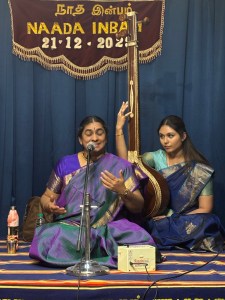
 Sumitra Vasudev gave a concert at Raga Sudha hall for Nada Inbam on 21st Dec, 2025 at 6:15 PM, accompanied on the violin by Padma Shankar and on the mridangam by Arun Prakash.
The famous vIribhOni varnam of Pachimiriam Adiappaiyer was rendered in single speed (one kalam) but she delivered the usually skipped third chittai swarams along with few more charanams.
A short sketch of the rAgA was followed by thulasidhalamulache SantOshamugha of tyAgarAjA. Of course, the elegant sangathi towards the end of the pallavi, the stamp of Vedavalli, was rendered with the same poise and melody. Neraval at the standard sarasiruga… line was well done embellished with tight brikkas throughout without making a show of the effort. Violin did a good suporting foil for both the neraval and the swarams that followed.
The next krithi, guruguha dhanyam set in misra jhampai in the rAgA balahamsa is a rarity rendered well.
This was followed by the first elaborate AlApanai in the rAgA AbhEri however delivered with the sudha dhaivatham instead of the chathusruthi one that had substituted in the last decades. The AlApanai was well built, classical and delivered without any cheap or ‘konjal’ phrases.
While listening to the elaboration and later during the swarams, I felt this is not an issue that could intrude into the listening pleasure of the rAgA. AbhEri can as well be shown, identified and exemplified – as the artist did – even without invoking any dhaivatham but using characeteristic phrases comprising the other notes.
The song rendered was kandhA vandharul composed by Papanasam Sivan. Radha Jayalakshmi has sung a version of this song. The same AbhEri rAgA structure (as presented here by Sumitra) was used by NC Vasanthakokilam to deliver ‘pithan endralum’ that is available on YouTube for our listening pleasure.
The song beginning with ‘Indha vibhIshanan mIdhu namaKu…’ set in khamAs was presented, followed by ‘namO namastE gIrvAni’ composed by Muthuswami Dikshitar. The rAgA gIrvAni is the 43rd mElakarthA, also known as ghavAmbOdhi or bhavapriyA.
After these two nice fillers, rAga AlApanai of sankarAbharanam, for the main piece began. The AlApanai developed straight in madhya sthAyi and flowed nicely wihout any cheap phrases or gimmicks even during the thara sthAyi sancharams. Padma Shankar followed in violin with an elaboration very similar in style to that presented by Sumitra but for the last minute or two.
Sumitra has immaculate voice and breath control, keeping everything melodious, either during AlApanai or while doing neraval and swarams, the rendition of phrases (rather, particularly) in the upper registers is bereft of any harshness in tone; not a single shout or screech. And to boot, no indulgence in excessive akArams or scale tumbling calisthenics. The moment the imagination for the day ends, even the main AlApanai is brought to a close in about eight minutes. Well done.
The main song is ‘sankarAcharyam’ set in Adi tAlam (2 kalai). Neraval was rendered with attention to bring out the nuances of the lyrics and the rAgA phrases. No thigh-palming smashing climax nevertheless elegant and fulfilling. A long stretch of swarams connected to a goo thIrmAnam completed the vocal section and lead into the thani avarthanam.
Arun Prakash immdediately went into ‘kanakku’ in kanda nadai and as expected successfully brought everything into scope to claim a deserving round of applause. His accompaniment was as usal sensitive and soft, at times played as if with marudhAni coated fingers. his mridhangam caught the cold from the air conditioner and frequently needed sruthi alignment, even the checking of which he did with soft fingers. Perhaps he should bang the instrument a few more times for it not to rear its sruthi!
Listening to Sumitra live after a decade, it is heartening to observe she has developed into a well rounded classical package without any rough edges of uncertainty or lack of imagination. She knows her art, which remains firmly classical, and her place, which is ensconsed securely in the patantara of Smt. Vedavalli. What a rich live listening experience awaits the rasikas in the coming years.
*
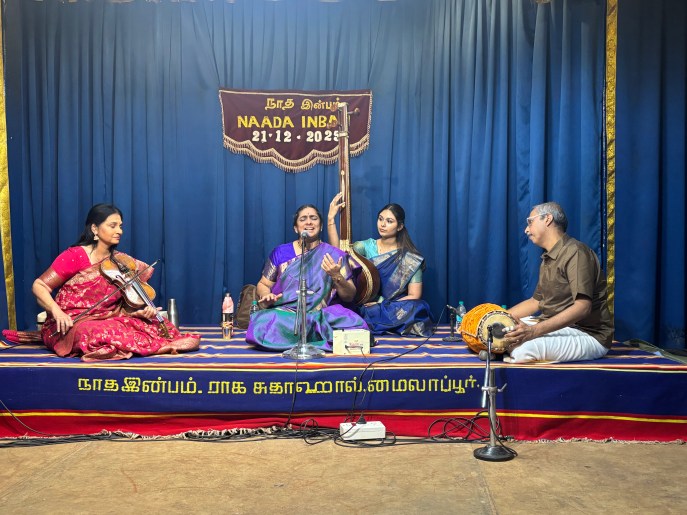
Sumitra Vasudev, Padma Shankar (violin) and Arun Prakash (mridangam)
 Arunn Narasimhan